A share is a slice of a real business.
When you buy a share, you become a legal part-owner, not just a number-watcher.
Your neighbour checks his phone every hour. He's watching the wrong thing.
Your neighbour Ramesh has been 'in the markets' for two years. Every tea break, he opens his app: red number, tension; green number, smile. But he has never paused to ask: is this company selling more? Are costs rising? Has the business actually changed? Ramesh is watching the scoreboard. He has not understood the game.
A company needs money to grow. One option is a bank loan. Another is to split ownership into millions of equal pieces. Each piece is called a share. Anyone who buys one becomes a legal part-owner.
In India, when you buy a share, your name is recorded in a ledger held by CDSL or NSDL — India's two official depositories. This is not symbolic. It is a legal record. You own a piece of that business.
Your ownership earns in two ways. If the business grows, buyers may pay more for each piece. That's your share price rising. If the company is profitable, it may also distribute some earnings as dividends — cash sent directly to your account.
The price on your screen is what a buyer agreed to pay a seller, at that moment, on that day. Tomorrow it could be different. The price is the market's daily opinion of the business. It is not the business itself.
The kirana shop that sold pieces of itself
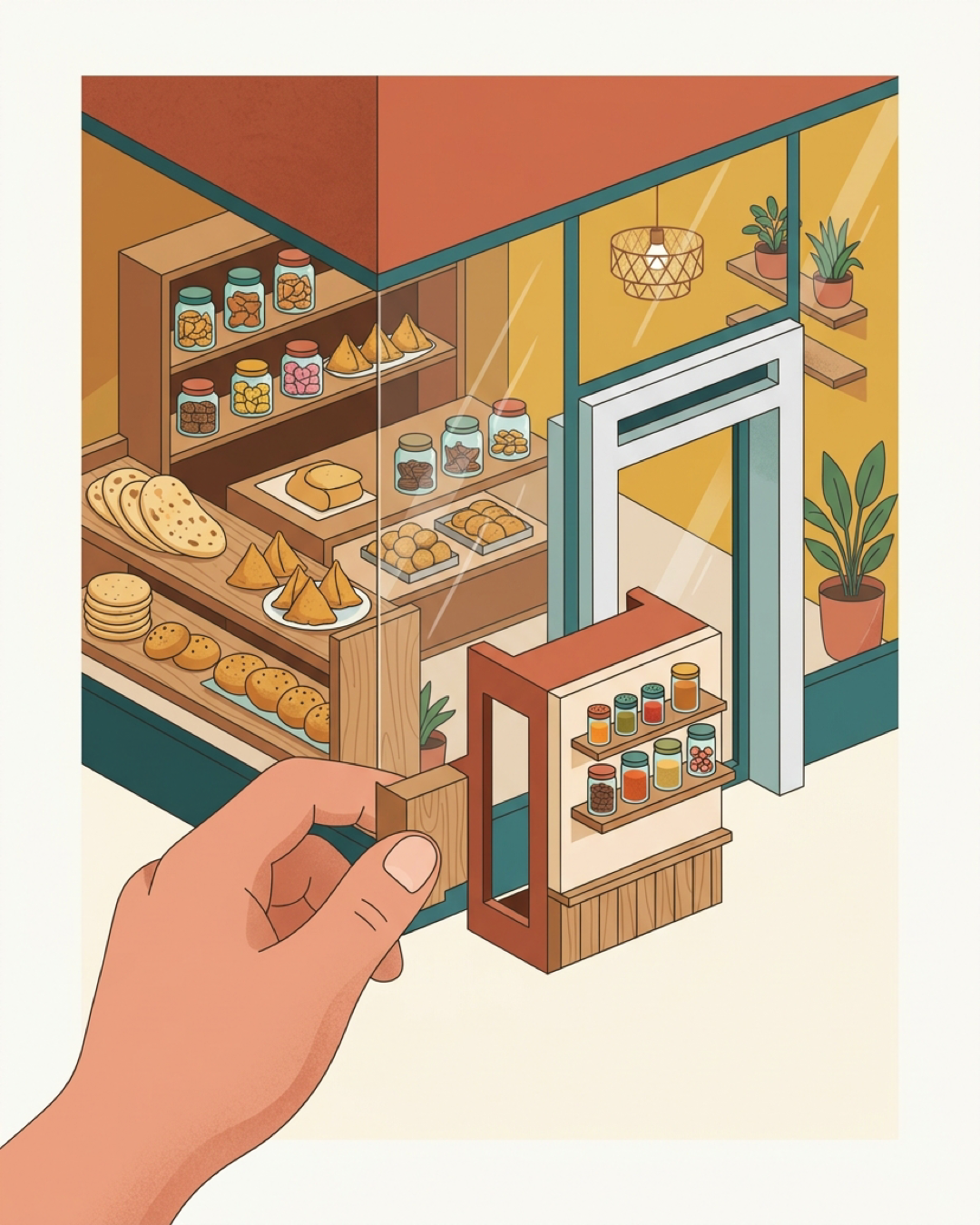
A kirana shop earns ₹1 lakh a year. The owner wants to expand but needs money. He divides the shop into 100 equal pieces and sells 40 of them to neighbours. Each buyer now owns 1% of the shop, its profits, and its future. If the shop earns more next year, each piece may be worth more. NSE and BSE make this idea possible at huge scale — with millions of pieces, many buyers and sellers, and any Indian with a demat account able to buy one.
Why this matters
You probably already understand assets that can grow: land, gold, a flat. A share extends that logic, but with one important difference. Instead of owning brick and mortar, you own a piece of a business that can earn money and reinvest it. ₹1,00,000 invested at 12% for 20 years becomes ₹9.6 lakh. The same amount at 6% becomes ₹3.2 lakh. The gap is not a screen trick. It is the difference between capital used well and capital growing slowly.
Own the business. Tune out the daily noise.
Where people go wrong
- Watching price as a daily scoreboardPrice is the market's opinion, updated by the minute. The business changes far more slowly. Treating every price move as a signal can make you sell the wrong thing at the wrong time.
- Confusing a high share price with a valuable companyA ₹50 share of a great business beats a ₹5,000 share of a weak one. Price per share in isolation means nothing — what matters is what you get for what you pay.
- Selling when the price falls after bad newsThe question is whether the business changed, not only whether the price moved. Market noise and business deterioration are different things. First ask what actually got worse.
- Buying because the brand feels familiarUsing a product is not the same as understanding the business behind it. Brand familiarity is a starting point for research, not a reason to invest.
A share is legal part-ownership in a real business, not a bet on a blinking number.
Price alone is meaningless. A ₹50 share of a great business beats a ₹5,000 share of a weak one.
Long-term, your returns track the business's growth, not the market's daily mood.
People stare at the price and forget to ask whether the business changed. That single confusion is what turns every market dip into a crisis.